
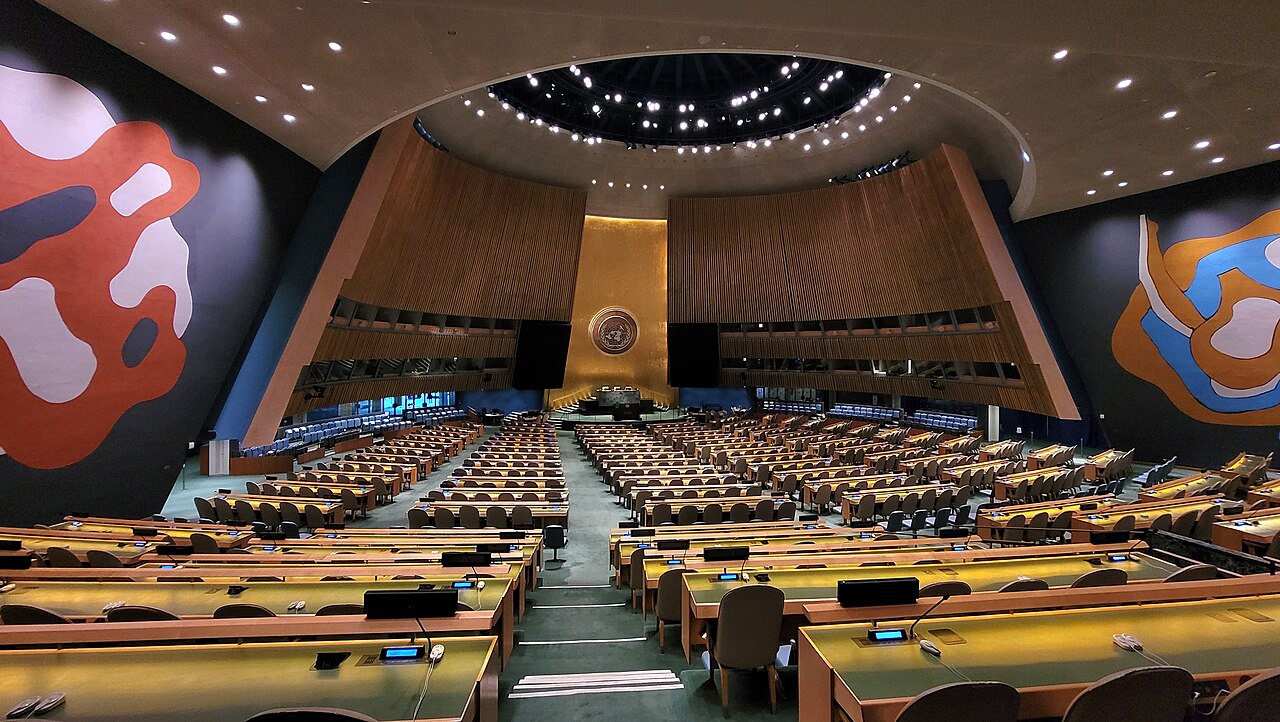
World leaders on Thursday approved by consensus the UN Declaration on Sea Level Rise, as UN Secretary-General Antonio Guterres warned that rising seas are already threatening homes, livelihoods and the future of coastal communities worldwide. The declaration taken during the meeting of the General Assembly in New York, marks the first UN-wide political framework devoted specifically to the growing legal, humanitarian and development consequences of sea-level rise.
The declaration calls for stronger international cooperation, faster emissions reductions, greater adaptation and resilience financing, and increased support for small island developing states and low-lying coastal countries. Nearly 900 million people already live in low-lying coastal zones, while more than one billion could face coastal hazards by 2050. Guterres told the meeting that global sea levels rose by almost six millimeters in 2024, the largest annual increase recorded, and warned that without substantial emissions reductions, average sea levels could rise by around one metre by the end of the century.
The UN International Law Commission began formally examining “sea-level rise in relation to international law” in 2019 and completed its work in 2025, focusing on three areas: the law of the sea, continued statehood and protection of affected persons. Its final report found growing state support for maintaining existing maritime baselines and zones despite physical changes to coastlines and found strong support among states for continuity of statehood, sovereignty and international legal personality despite climate-related sea-level rise.
Those questions arise partly under the UN Convention on the Law of the Sea (UNCLOS), which establishes rules governing maritime zones measured from coastal baselines, including territorial seas and exclusive economic zones, as well as continental-shelf entitlements. The International Law Commission concluded that the Convention does not require states to update baselines, geographical coordinates or the outer limits of maritime zones once duly deposited with the Secretary-General to account for changes caused by climate-related sea-level rise.
International courts have also begun clarifying climate obligations at sea. In its 2024 advisory opinion, the International Tribunal for the Law of the Sea held that anthropogenic greenhouse-gas emissions can constitute marine pollution under UNCLOS and that states have obligations to prevent, reduce and control such pollution and protect the marine environment from climate impacts, including sea-level rise. Small island states have long pushed for recognition of continued statehood despite territorial loss, including through Pacific Islands Forum and AOSIS declarations in 2023 and 2024.
The new declaration does not resolve every legal issue. Questions remain over relocation, nationality, compensation, cross-border displacement and how governments can continue exercising authority if populations are forced to move abroad. The International Law Commission has emphasized that people affected by sea-level rise retain protections under international human-rights law, including rights connected to self-determination, nationality and protection from displacement.
The declaration emerged from a process launched by General Assembly Decision 78/558 in 2024, which mandated the 2026 high-level meeting and called for an action-oriented declaration negotiated by consensus. Member States have agreed to return to the issue before the end of the General Assembly’s 84th session, shifting attention from recognition of the legal problem toward implementation, financing and protection of communities already facing territorial loss.

